What Is IVC Filter Placement?
Inferior vena cava (IVC) filter placement is a minimally invasive procedure used to prevent large blood clots from traveling from the legs to the lungs, where they can cause a life-threatening condition known as pulmonary embolism (PE).
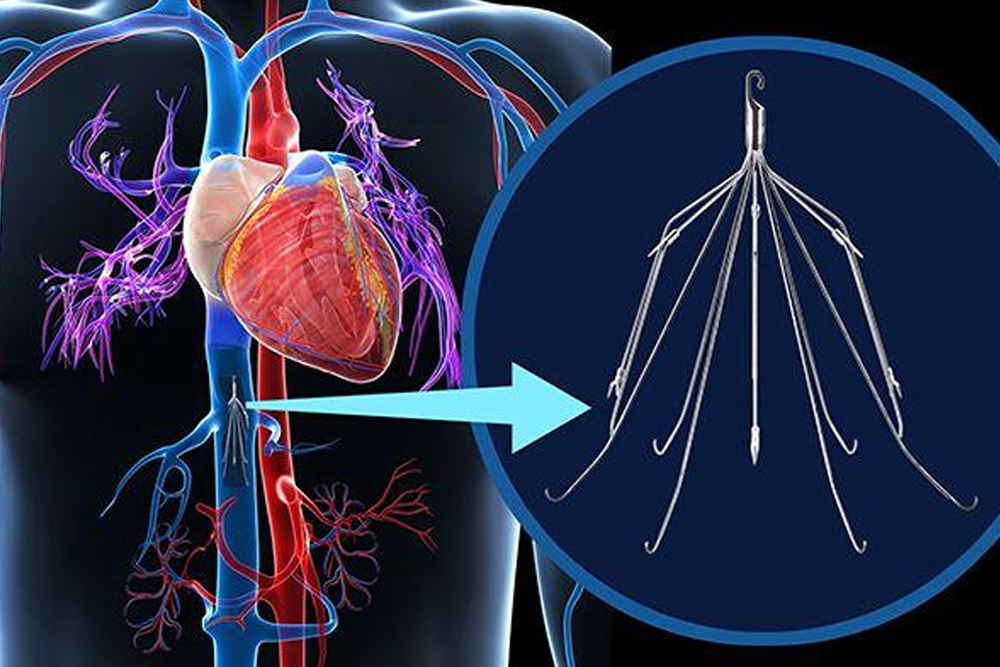
During the procedure, an interventional radiologist places a small, medical-grade metallic device called an IVC filter into the inferior vena cava. The IVC is a large vein in the abdomen that carries blood from the lower body back to the heart. The filter is typically positioned just below the veins that drain the kidneys.
Benefits of IVC Filter Placement
Minimally invasive
The procedure does not require large incisions or general anesthesia, which significantly reduces procedural risk and recovery time.
Generally painless
Most patients do not experience pain from the filter after it is placed.
Outpatient convenience
IVC filter placement is commonly performed on an outpatient basis in an interventional radiology setting. If a patient is already hospitalized, the procedure can also be performed as an inpatient.
Rapid recovery
Recovery time is minimal, and most outpatients return to their normal level of activity within an hour after the procedure.
High effectiveness
IVC filters are highly effective in reducing the risk of pulmonary embolism in appropriately selected patients.
Removable option
Most modern IVC filters are designed to be retrievable. Once the blood clot resolves or anticoagulation therapy becomes safe, the filter can be removed. Even if an IVC filter was placed at another facility, the team at ViP can evaluate and perform filter removal when appropriate.
FAQ
1. Is IVC filter placement considered major surgery?
No. IVC filter placement is a minimally invasive procedure, not major surgery. It is performed using local anesthesia, X-ray imaging, and thin catheters to guide the filter into position. Most patients undergo the procedure on an outpatient basis and recover quickly because there is no need for general anesthesia or large abdominal incisions.
2. How should I prepare for IVC filter placement?
Before your procedure, your care team may order blood tests to evaluate kidney function and blood clotting. It is important to inform your doctor about all medications and supplements you are taking, as some may increase the risk of bleeding. You may be asked to avoid eating or drinking for several hours before the procedure. Because sedation is used, you should arrange for someone to drive you home afterward.
3. What happens during IVC filter placement?
During the procedure, you will lie on your back while nurses administer intravenous sedation and connect monitors to track your vital signs. Your physician will numb the access area with local anesthesia and make a small incision, usually in the upper thigh or neck.
A thin catheter is inserted into a vein and guided to the inferior vena cava using X-ray imaging and contrast dye. Once the catheter is in the correct position, the collapsed IVC filter is released. The filter expands and attaches securely to the walls of the vein to trap large blood clots.
4. What is recovery like after IVC filter placement?
After the procedure, you will be monitored in a recovery area for a few hours. Once cleared by the medical team, you will be discharged with instructions for home care. Most patients return to normal activities the following day. Mild soreness or bruising at the access site is common and usually resolves quickly.
5. How effective are IVC filters?
IVC filters are highly effective at reducing the risk of pulmonary embolism. Studies show that pulmonary embolism occurs in approximately 1.3 percent of patients after filter placement. Although rare, potential issues can include filter migration, tilting, or clot formation around the filter.
6. How long does an IVC filter stay in place?
The Food and Drug Administration recommends removing retrievable IVC filters within one to two months when it is medically safe to do so. This timeframe is often sufficient for the risk of pulmonary embolism to decrease or for alternative treatments to be initiated. Leaving a filter in place longer than necessary can make removal more difficult. In some cases, patients may need the filter for a longer duration to ensure safety.